Decks on a cruise ship are numbered from the bottom up, starting at Deck 1, and the steadiest cabins for motion sit low and midship. Higher decks give better views but sway more.
The mechanism is simple: numbering tells you where you are, and height and position along the hull decide how the ship feels. If you are still choosing a sailing, start with how to book a cruise, then use the deck plan to pick your spot.
How deck numbering works
Cruise ship decks are numbered from bottom to top, starting from Deck 1 and rising to Deck 20 or more on the largest ships, according to CruiseNation’s guide to deck plans. Knowing the order makes every other choice easier, because a higher number always means a higher position on the ship.
Where passengers actually start
Most passengers board on Deck 4 or Deck 5. The decks below that are mostly not accessible to passengers, so the lowest numbers you will see on a deck plan are usually working areas rather than cabins or lounges. When you compare ships, count upward from the boarding deck rather than from Deck 1, and you will judge how far a cabin sits above the waterline.
Reading a deck plan
A deck plan shows where venues and staterooms sit on each level. CruiseMapper’s deck plan library lists 1324 vessels and 8955 deck plan images, and each vessel page links to a review of the passenger staterooms. Use the plan to check what sits directly above and below a cabin before you commit, because neighbouring decks decide most noise and traffic.
What is on each deck
Ships tend to stack their social spaces at the top and put cabins in the middle, with the details varying by line. These are the deck names you will meet most often.
The Lido deck and pool deck
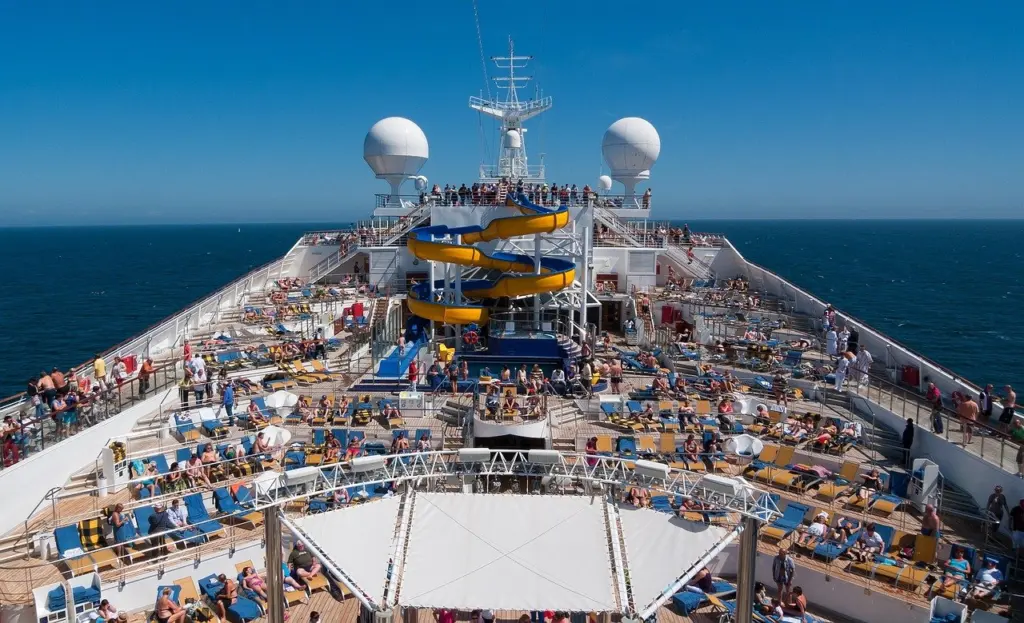
Cruise Overload describes the Lido deck as often considered the heart of a cruise ship. It is typically the top-most open deck, where most outdoor activity happens, with pools, hot tubs, water slides, bars and open-air cafes. The name traces back to the Lido di Venezia district in Venice, Italy. The same guide notes that the Sun Deck is usually the highest deck on the ship.
Expect noise and crowds here. CruiseNation calls the pool deck a hive of activity on just about any cruise ship, and says the deck below tends to be far quieter.
The promenade deck
A promenade deck is an outdoor area that fully or partially encircles the ship, as CruiseMapper defines it. It usually offers a wrap-around walking path with ocean views. The label no longer guarantees a full circuit, though. According to Ellie’s Travel Tips, some promenades are partial, stepped or indoors.
Royal Caribbean shows how far the term can stretch. Its Royal Promenade is an internal, multi-story neighborhood running through the ship, not an outdoor walkway. If a walk by the sea matters to you, check the plan for an open-air track rather than relying on the name.
Cabin decks
On many ships the Main Deck predominantly hosts cabins. Cabin decks sit between the busy public levels, so the next section covers how height and position change what you feel in the room.
Cabin decks, motion and comfort
Motion depends on two things: how high the deck is, and how far forward or aft the cabin sits. The top of the ship tends to sway more than the bottom, so lower decks near the waterline feel calmer than upper ones. A midship position on a lower deck usually experiences less pitching than a high forward or aft location.
| Location | What to expect | Planning use |
|---|---|---|
| Lower deck, midship | Usually less pitching than a high forward or aft cabin | The first choice if motion worries you |
| Lowest passenger decks | Less sway, but too close to the water for balconies | Accept a window or inside cabin in exchange for calm |
| Upper decks | More sway, better views | Suits travelers who tolerate motion and want the view |
| Mid-level decks | Fewer floors to climb | A balanced choice if you will move around the ship often |
| Traditional promenade deck | Often on lower passenger decks, closer to the ship’s center of gravity than top-deck tracks | A steadier place to walk than a top-deck track |
These comparisons draw on CruiseNation and Ellie’s Travel Tips.
Midship cabins
Midship cabins are the practical answer to the question of which deck is best for motion sickness: choose a lower deck and a midship position. The trade-off is the view, because the more you climb the ship, the better the view becomes. Choose midship low if comfort comes first, and higher if scenery does.
Balcony and inside cabins
A balcony room can help with motion discomfort compared with a windowless inside cabin, since fresh air and a view of the horizon make the experience more pleasant than fighting motion sickness in a sealed room. Balconies are not available everywhere. The lowest cruise ship decks have none because they sit too close to the water, so the calmest decks and the balcony decks do not fully overlap. A mid-level deck can be a reasonable compromise.
Check what the window actually faces. On Royal Caribbean’s Navigator of the Seas, the Promenade View Interior and Connecting Promenade Interior categories have windows onto an indoor public space. They do not provide an ocean view or fresh air, so they do not give the balcony benefit.
Choosing a deck by priority
Decide which factor you cannot compromise on, then let it set the deck.
- Motion comfort: book a lower deck midship, and consider a balcony only if the plan shows one that is not too close to the water.
- Views: go as high as you can tolerate. Expect more sway in exchange.
- Quiet: pick the deck directly below the pool deck rather than the pool deck itself, since that level tends to be far quieter than the one above it.
- Ease of getting around: a mid-level deck means you will not face too many floors to climb.
- Family needs: look at how close the cabin sits to the activity areas. Our guide to the Best Cruise Ship For Kids: Top Family-Friendly Picks And How To Choose In 2026 – Electracruises compares ships on that front.
- Top-end cabins: if you are weighing suites and premium decks, Inside The Most Luxurious Cruise Ship In 2026: What Makes It Worth The Splurge – Electracruises shows what the highest tier looks like.
Before paying, open the deck plan for your exact ship and look at the decks directly above and below your cabin. A calm, well-placed cabin under a nightlife deck loses much of its advantage, and a plan view shows that in seconds.
Frequently asked questions
Do all cruise lines number decks the same way?
Numbering generally runs bottom to top, but some lines add names. On MSC Grandiosa, for example, decks are named after famous artists such as Monet and Van Gogh, so check the plan for the ship you are booking.
On which deck do passengers board?
On most ships you board on Deck 4 or Deck 5, and anything lower is mostly not accessible to passengers.
Why is it called the Lido deck?
The label is drawn from Venice’s Lido di Venezia district in Italy.
Does a promenade deck always go all the way around the ship?
No. The promenade label no longer guarantees a full circuit, and some promenades are partial, stepped or indoor.
Why do the lowest decks have no balconies?
They sit too close to the water, so the lowest passenger decks do not have balconies.